

Residents that have collections starting week beginning Monday 14 December, can add a reminder to their calendar [ICS, 1Kb].
Background
During 2026, all households across South Cambridgeshire and Cambridge will receive a new weekly food waste collection service.
This additional service is part of new national legislation requiring councils to collect food waste separately. It will help boost recycling rates and reduce the amount of food sent to landfill.
Food in landfill produces methane, a greenhouse gas, so using this new service is an important step we can all take to limit climate change.
The majority (73%) of food waste comes from households (the rest coming from retail, hospitality and manufacturing). Having a weekly collection service in a separate bin has been proven to increase the amount of food waste collected for recycling.
When collections will start
We will be introducing the service in phases throughout 2026. We will write to residents in advance with specific information, including the start date. The collection dates will also show on your bin collection calendar.
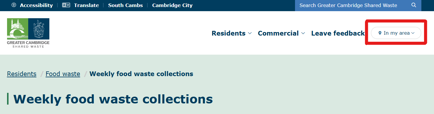
You can also find out when the service will start in your area by typing your postcode into the In My Area section at the top right-hand corner of this page.
Feedback survey
If collections have started for you, please share your feedback by completing our short survey
Requesting a replacement outdoor caddy
If your food waste collections have already started and you need to request a replacement outdoor caddy (lost or damaged), please use our request a bin form and we'll arrange for delivery within 10 days.
Please note, we do not replace indoor kitchen caddies. You can use any caddy or box with a lid (such as an ice cream tub) to collect your food waste in the kitchen.
How the service will work
All residents will receive a small indoor kitchen caddy to collect food waste in. If you have your own blue, black and green bins, you’ll receive a larger outdoor caddy for collection which should be placed next to your other bins on collection day. The outdoor caddies are animal-proof with lockable handles. Keep lids closed and avoid overfilling to reduce the chance of it tipping over. Please do not put the kitchen caddy out for collection as it will not be emptied.
If you live in flat, you will have a shared bin to empty your food waste into which will be stored with your other shared bins. In some cases where flats have insufficient space in the bin store, a separate bin housing will be installed in a communal location.
Assisted collection customers will automatically receive assisted food waste collections.
You’ll receive a starter roll of caddy liners. These are plastic but do not affect the processing of the food waste as they are removed in the first stage of treatment. While reducing plastic is important, collecting food waste matters most. Plastic liners help prevent flies, mess and smells and they are also a cost-effective option. Keep your caddy lids closed and empty your indoor caddy frequently. When you have finished the roll of liners provided, we will not provide more. You can use any liner in your caddy (including 'compostable plastic' ones available in shops), or none - if you're using plastic ones, you must be able to see the food waste through the liner so our crew can be reassured that no other waste is inside.
Home composting is still encouraged, but using the food waste caddy lets you recycle items like meat, fish, bones, cooked food, and dairy, which shouldn’t be composted at home as they attract vermin. No amount is too small. Collect tea bags, bones, eggshells, onion skins, and fruit peels; you might be surprised how much you throw away.
What you can put in your food waste caddy
You can recycle the following with the new food waste collection service:
- all uneaten food and plate scrapings
- raw and cooked food (including mouldy food)
- fruit and vegetables (including peelings, pips and stones)
- meat and fish (including bones)
- dairy (cheese, eggs, eggshells, yoghurt)
- bread, cakes, pastries, rice, pasta
- tea bags and coffee grounds
- kitchen roll
Please do not put the following in your caddy:
- packaging of any kind (including ‘compostable plastic’ plates, cups etc.)
- liquids such as milk
- oil or liquid fat
- shells from shellfish
- tissues
- anything else that is not food waste
Once your weekly food waste service starts, you should stop putting food waste in the green bin and use this only for garden waste, as we want as much food waste as possible collected by the new service. Windfall fruit counts as garden waste and can go in the green bin, but be aware that heavy bins can trigger the lorry’s weight sensor and prevent them being emptied.
Managing your food waste in hot weather
Using your weekly food waste collection is the best way to dispose of food scraps, and will prevent your kitchen bin from smelling or producing 'bin juice'. In hot weather it’s best to:
- Put food scraps in your caddy straight away. Food left out on plates or surfaces gives flies an opportunity to land and lay eggs on it
- Use a liner in your indoor caddy, don't overfill it and tie it securely when emptying. Keep the caddy lid firmly shut between uses by securing the handle in the up position
- Empty your indoor caddy frequently; every day is recommended in very hot weather. Tie the liner closed (or fold down if using paper liners), place in your outdoor caddy and secure the lid in the locked position
- Store your outdoor caddy out of direct sunlight.
Fly eggs can hatch in 24 hours in hot weather. If you find maggots in your outdoor caddy don’t worry; although unpleasant they are harmless. After collection leave your caddy open and lie it down for a while and they will disperse or be eaten by birds. You can then wash out the caddy.
Where your food waste will go
Food waste will be taken to an Anaerobic Digestion (AD) Plant. This is a separate facility from where your garden waste will be composted.
At the AD plant, caddy liners are mechanically removed and used as a fuel to generate energy, and the food is broken down in the treatment process without oxygen present. This creates biogas which is captured to generate electricity. Fertiliser is also produced, which is used in farming.
Missed collections
While we will not return to empty missed outdoor caddies, please report it using the missed bin form. Notifying us helps improve our service and minimise future misses. If you run out of space in your caddy before the next collection, please put the food waste into your black bin.
If you live in a flat and your shared food waste bin has been missed, please fill in the missed bin at flats form and we will return to empty these.
Information leaflets
Download a copy of your food waste collection leaflet:
- Houses leaflet [PDF, 4MB] (if you have your own outdoor caddy for collection)
- Flats leaflet [PDF, 4MB] (if you share bins with others)
- Flats bin store poster [PDF, 2MB]
Caddy drop-off locations
After the distribution, we will not collect unwanted caddies from your property. If you already have a caddy or received one during the trial in 2020, you may keep the new ones as spares or repurpose them. Alternatively, you can drop off new, unused caddies (not old ones) at any of the locations listed below. Specific locations are using What 3 Words
|
Site |
Specific location |
Opening hours |
Available between |
|
Milton Park & Ride Milton |
|
24 Hours |
7th September – 21st December |
|
South Cambs Hall Cambourne Business Park Cambourne CB23 6EA |
Customer service desk |
09:00 – 16:00 Monday - Friday |
7th September – 21st December |
|
Thriplow Recycling Centre Gravel Pit Hill Thriplow SG8 7HZ |
Site staff to advise |
08:00 – 16:00 Everyday |
7th September – 21st December |
|
Trumpington Park & Ride Trumpington |
|
24 Hours |
7th September – 21st December |
Reducing food waste
Once you begin using your new weekly food waste collection service, you will probably notice how much food you are throwing away each week. Eight out of ten people think that they waste less food than average, but in fact most people throw away quite a lot of food which could have been eaten, if it was used up in time. Find out more about reducing food waste
You can contact us if you have any queries about your weekly food waste collection service.